Showing posts with label living room. Show all posts

The New Three Storey Living Space Design, Mosman House

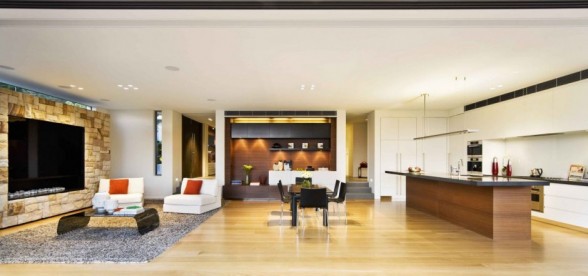
A living space design called Mosman House which is located in Sydney, Australia is completed designed by the Corben Architects architecture design. This new three storey living space project has four bedrooms. This north facing residence is sited on a battle axe block. This house is designed to take a maximum advantage of the put standing water views and maintain the absolute privacy to the adjacent neighbors. To adhere to the local approving authority’s views sharing the policy and ensure the minimal view loss to the neighbors behind, this building is replaced a small older single level house style and have to be skillfully designed for it.


The living space is concealed behind a timber battened garage door and entry gate to the street, but then reveals itself as one enters of the site and moves through the landscaped garden from the front gate to the front door. Only glimpses of the panoramic water view which are lies beyond are revealed along this journey. By entering the house and keep moving into the large open plan Living/Dining/Kitchen, the full impact of the stunning views is felt. The substantial living space with its large sliding windows and high ceilings flows out and becomes one with the outside encouraging the indoor/outdoor lifestyle. The two living areas and the guest wing are located on the middle level with three bedrooms on the upper level, while the main one designed as a luxury suite, they are exist in the main entry. In the lower level is incorporates a large rumpus / media room and the store areas.


The building is a simple rectilinear form of the concrete and the masonry construction, then to present a modern home with a focus on the natural materials and the clear design principles; it is carefully layered with a timber battening and the sandstone cladding. The incorporate American Oak timber floors to the living areas are finishes the interior design. To the circulation areas is honed the Grey Limestone. The Walnut veneered joinery, white polyurethane cupboards, Quartz kitchen bench tops and the Marble slabs in the bathrooms to create a contemporary, sophisticated interior with a warm inviting feel.


To provide the thermal mass and the Energy Efficient which is glazing to the external windows and the doors, energy saving option is adopted including an operable skylight over the central core which is allowing the natural light and ventilation. This house design is also consists of a rainwater harvesting system which is comprisees of 30,000L rainwater tank, it is used for the garden irrigation and flushing of the toilets.


The finished house is a fine example of an understated but luxurious house which is takes the maximum advantage of a difficult site.

Narrow Wooden Design Farquar Lake Residence House Architecture

Situated in Apple Valley, USA, contemporary narrow house architecture design idea called Farquar Lake Residence comes from ALTUS Architecture + Design. It is located deep within wonderful natural forests view and guarding a gorgeous lake. The luxury house interior design features plenty of active outdoor spaces like beautiful landscape green gardens and playgrounds, but also innovative floor to ceiling windows for taking advantage of the stunning views.


The unique wood-clad wings design of the home sit on a blue-stone “outcropping” that extends the natural entry grade, grounding the residence. A series of bluestone monolith steps extend from the lakeside terrace toward the shore. The modern living room decorating layouts is mostly fascinating, as the wide glass connects the people indoors through the scenic outdoor comfortable atmosphere. The Farquar Lake Residence interiors are eye-catching, housing contemporary furniture design and modern minimalist decorating elements. The client’s desire was to have a luxurious residence which would ensure a connection with the natural landscape and that would reflect an active style of living space.


Designer in the living room

Living room - this is the room where you can spend a great deal of time working, relaxing, celebrating holidays. Therefore, in order of importance, we propose first to consider how to change the interior in the living room.

The most radical, but a suitable and efficient method - overdye wall in the living room. This is the most radical option, but good: a little try now to prepare walls for painting, since you can change colors as often as you wish. We recommend that you experiment a bit with the flowers: the central or most prominent wall pokraste in a certain color, while the other walls in other shades of the same color. You do not even know your living room: it was so pipe up in different colors. Can a wall plastered with paper, but other colors are painted in tones of wall-paper - will also look very attractive and unusual. The most creative nature can not dwell on the usual paint and done, for example, a quote from any work through the stencil and thin brushes.

When painting, do not rush to return all the furniture in the room, it is better to give yourself more space, it shows how life is unnecessary items in the room, which serve as ornaments, but this function perform poorly, and are not used frequently.

If you have a living room not only for leisure but for work, then invite you to isolate the two zones: the working and living. The border should not be insurmountable, it is usually enough visual effect: different shades of colors, textures carpet. You can make shelves for books or a mobile bulkhead. If the rail I do not want to or not possible, then you can just hide the computer and all equipment in the special secretaire, that he and the place is not occupied and does not disturb relax. For conductors, there are special boxes, which are up to 5 wires.

Old furniture, which you keep as a memory better than does this by removing and give it a new form through repainting or decoration. The practice shows that the old things still do not lose their attractiveness, and the functions performed well.

To refresh old sofa would suffice to purchase new blankets.

And if you have gathered to change the furniture in the room, while looking a furniture version of transformers on wheels.

To decorate the room accessories of different types and forms, take the basis of one tone, and then you no longer exist doubts whether they are suited to each other.

Okay fine mirrors in the room, which can visually expand the space of the living room and give her chic look.


SEATTLE CENTRAL LIBRARY


The first official building to house Seattle's public library was built in 1891 on Pioneer Square, eventually moving to a block bounded by Fourth and Fifth Avenues and Madison and Spring Streets. In 1998, Seattle voters embraced a $196.4m makeover of the library, dubbed 'Libraries for All'.

The initiative includes plans to double the square footage in Seattle's 22 libraries, including the building of new branches – but the icing on the cake is the new $169.2m Central Library at 1,000 Fourth Avenue, designed by Rem Koolhaas' Netherlands-headquartered Office of Metropolitan Architecture (OMA) in joint venture with local LMN Architects.

Partnering Koolhaas on the OMA team was another well-known name, Joshua Prince-Ramus, now of REX Architects in New York. 37 library staff groups and 11 public work groups were involved as well, according to a library statement.

SEATTLE CENTRAL LIBRARY FEATURES

OMA / LMN's creation opened in 2004 after 2.5 years of construction as an 11-floor, 412,000ft² library.

It includes such innovative features as a 'book spiral' on levels 6-9 that displays the entire non-fiction collection in a continuous run, and a 50ft-high living room alongside Fifth Avenue, all housed in a distinctive diamond-shaped glass and steel skin.

4,644t of conventional steel columns not only carry the weight of the building but support lateral loads such as wind and earthquake movement and the weight of the exterior building skin or curtain wall. The diamond-grid 'smart glass' was made by Okalux and custom-made by Germany's Seele.

Five platform areas allow form to follow function, each corresponding with different aspects of the million-book Central Library programme. The interior has been described as awash with natural light and space, inspiring users to read and borrow actual books in today's world of online texts and multimedia presentations.

The 'Mixing Chamber' on level 5 hosts a customer help centre, including 132 of the building's 400 public computers.

The 'Living Room' on level 3 features a teen centre, family fiction collection, shop, coffee bar, auditorium, the Library Equal Access Project and spaces to read or study. 'Living Room' flooring uses a recycled product called Worthwood made by Oregon Lumber.

A 'Seattle Room' on level 10 houses Seattle history and genealogical services. This level also houses the reading room, which has panoramic city views. Level 9 hosts a map room and writers' room. A children's centre on level 1 has special reading rooms.

A cross section of the new Central Library shows the 'mixing chamber'
customer help area and several purpose-built reading rooms.

HIGH-RISE MODIFICATION

"By modifying the superposition of floors in the typical American high-rise, a building emerges that is at the same time sensitive (the slopes will admit unusual quantities of daylight where desirable), contextual (each side can react differently to specific urban conditions) and iconic. Its angular facets form a plausible bracketing of Seattle's new modernity," OMA wrote.

Black wall tiles were made from a porous bead foam sound silencer called EPP-ARPRP sold by Acoustical Surfaces. Carpets were designed by Petra Blaise of Inside / Outside in Amsterdam, using Ege carpet of recyclable nylon or polyamid, from the UK. Level 10's 'pillow' ceiling is acoustic panels wrapped with ripstop nylon.

There are 731 seats at study tables without computers and 190 lounge seats, not counting seats for meeting rooms, out of a total $6.4m furniture budget. It includes a 275-seat auditorium and parking for 143 vehicles. The Central Library now sees two million physical patrons a year.

According to a statement from OMA, the library seems threatened, a fortification ready to be taken by potential enemies. "New libraries don't reinvent or even modernise the traditional institution; they merely package it in a new way," the architects wrote.

OMA's vision was to redefine the library as no longer exclusively dedicated to books but as more of an information store, where all media can be presented. "In an age where information can be accessed anywhere, it is the simultaneity of all media and the professionalism of their presentation and interaction that will make the library new," OMA wrote.

LIBRARY AWARDS

Seattle's new Central Library has won various awards, including the American Institute of Architects 2005 Honor Award, the American Council of Engineering Companies' 2005 Platinum Award for Innovation and Engineering and achieved a silver rating from the US Green Building Council.

White Interiors


In East Hampton, New York, architect and designer Russell Groves gave a modern beach house “a fresh outlook.” Groves designed the sofa, armchairs and the travertine-topped low table in the double-height living room, which he opened up with new fenestration and neutral hues.


Interior designer Jennifer Post maximized drama in a minimalist Tribeca penthouse by using strong contrasts, rich materials and abundant natural light. The family room—“the evening hub and entertainment area,” says Post—leads out to a walled private terrace. As with the other public rooms, comments the wife, “I was very adamant that we not have draperies because of the openness and the clean lines.”


Fashion designer Ralph Lauren and his wife, Ricky, bought a Jamaican villa on Round Hill, near Montego Bay, some 20 years ago. “It’s a place where you really love where you are,” he says. Marble floors were installed in the living room.


A Tribeca penthouse’s dramatic spaces and stylish, streamlined look evolved out of a couple’s collaboration with design firm Sills Huniford and architect Robert Kahn. Bead-board cabinetry adds “warmth and texture” to the kitchen, which is “clean and sleek,” observes James Huniford. The bleached table, originally a glossy black, was formerly the wife’s writing desk. “We reused beautiful or loved things the couple already owned.”


Light and elemental purity distinguish an apartment designed by architects Michael Gabellini and Kimberly Sheppard that virtually floats above the panoramic New York City skyline. The kitchen appliances and millwork contribute to the clarity and harmony of the apartment as a whole, in which light, form and material coexist within a minimal envelope,” says Gabellini.

Interior designer Mariette Himes Gomez and architect Oscar Shamamian together handled the conversion of two separate apartments into a single, unified whole for a Manhattan family. The resulting 5,000-square-foot duplex penthouse’s entrance hall has a circa 1820 cherrywood center table and a circa 1830 French mahogany fauteuil, both from Lee Calicchio. Chair fabric, Rogers & Goffigon.

Living Rooms


Designers Stephen Sills and James Huniford, of Sills Huniford, worked with architectural designer Robert Rich to expand a couple’s 18th-century saltbox in upstate New York into a weekend retreat. The designers retained the living room’s original wood floors and incorporated a soothing palette. “This house is not about moldings,” says Huniford. “It’s about light and comfort.”

Richard Meier


In designing the interior architecture and décor of an apartment in one of Richard Meier’s
Glass Towers on Manhattan’s Hudson river, Peter L. Shelton and Lee F. Mindel carved out serene spaces while honoring the building’s modernist aesthetic. Midcentury furnishings, like the Poul Kjaerholm rattan chairs in the living area, set the tone.


For the Rachofsky House in Dallas, Meier created a space for both an individual to live as well as an international private collection of artwork. Meier made “art a part of the experience” in the house, with a focus on light and hard lines.


Living Rooms

From Classic to contemporary, a few of the most inviting and stylish living rooms :


A tranquil palette characterizes a Los Angeles living room designed by Mariette Himes Gomez.


Richard Meier & Partners’ recent expansion of the Friesen House in Los Angeles involved adding a story perched on a platform straddling the original 1953 structure. Besides acting as a backdrop for the fireplace in the master bedroom, the concrete shear wall adds lateral stability to the house and supports the second story construction.

Living Rooms


Interior designer Jennifer Post maximized drama in a minimalist Tribeca penthouse by using strong contrasts, rich materials and abundant natural light. The limestone fireplace and ebonized-white-oak cabinetry establish the palette that prevails in the living/dining room, as throughout.


Shelton, Mindel & Associates conceived and arranged a Manhattan loft for Claude Arpels. “The gestures of the design are in keeping with the original industrial vernacular of the building,” explains Lee F. Mindel. Near a Poul Kjaerholm armchair and sofa in the living room is a Charlotte Perriand wood bench. “Most of the furnishings we chose are by architects who understood the technology of their time. Their design philosophies are present in the furniture,” Peter L. Shelton says.