Showing posts with label American Institute of Architects. Show all posts

Frank Lloyd Wright-A Man Far Ahead of His Time

Frank Lloyd Wright (born Frank Lincoln Wright, June 8, 1867 – April 9, 1959) was an American architect, interior designer, writer and educator, who designed more than 1,000 projects, which resulted in more than 500 completed works. Wright promoted organic architecture (exemplified by Fallingwater), was a leader of the Prairie School movement of architecture (exemplified by the Robie House, the Westcott House, and the Darwin D. Martin House), and developed the concept of the Usonian home (exemplified by the Rosenbaum House). His work includes original and innovative examples of many different building types, including offices, churches, schools, skyscrapers, hotels, and museums. Wright also often designed many of the interior elements of his buildings, such as the furniture and stained glass.


Wright authored 20 books and many articles, and was a popular lecturer in the United States and in Europe. His colorful personal life often made headlines, most notably for the 1914 fire and murders at his Taliesin studio.


Already well-known during his lifetime, Wright was recognized in 1991 by the American Institute of Architects as "the greatest American architect of all time".


His work includes original and innovative examples of many different building types such as offices, churches, schools, hotels, and museums. He was the architect of the Imperial Hotel in Tokyo, Japan and spent almost three full years in Tokyo between 1917 and 1922 to design the hotel. During this time, he acquired thousands of woodblock prints for himself and other prominent American collectors. In his later years, he sold these woodblock prints to support himself financially.


Frank Lloyd Wright was born in the farming town of Richland Center, Wisconsin in 1867. He changed his name from Frank Lincoln Wright to Frank Lloyd Wright after his parents' divorce in 1881 when he was 14 years old, to honor his mother's Welsh family, the Lloyd Joneses. Prior to his parents' divorce, Anna, his mother, had been unhappy for some time with his father, William's inability to provide for his family. After the divorce, Frank assumed financial responsibility for his mother and two sisters as the only male left in the family.


Interest in Japanese Art
Wright attended a high school in Madison, Wisconsin but there is no evidence he ever graduated. He was admitted to the University of Wisconsin at Madison as a special student in 1886. He took classes part time and in 1887, he left the school without taking a degree, although he was granted an honorary Doctorate of Fine Arts from the University in 1955. He moved to Chicago and joined an architectural firm of Joseph Lyman Silsbee in 1887. While working for Silsbee, Wright meets Silsbee's cousin, Ernest Francisco Fenellosa, who happened to be America's foremost expert on Japanese art. Fenellosa stayed with Silsbee on his visits and at one meeting, Wright was shown the Japanese woodblock prints which Fenellosa had brought with him. Wright later recalls that "when I saw the fine prints, it was an intoxicating thing". Seeing these prints sparked an interest in Wright on Japanese art and architecture. What especially interested him was harmony with nature, simplification, honest use of materials and minimal decoration.


As background information, Japan had been closed to foreigners for more than two centuries beginning in the 1630s; this foreign policy remained in effect until the arrival of Commodore Matthew C. Perry in 1853. This led to the opening of Japanese ports to foreign trade and the artistic benefits which came from it were to be seen almost immediately in Europe. By the 1870s, there was a steady flow of Japanese art and artifacts to Europe, particularly France. The Japanese woodblock prints, or the "uki-yo-e" (meaning "pictures of the floating world") especially inspired the leading artists of the time, such as Manet, Degas, Gauguin, and Van Gogh. What was happening in Europe, particularly France, eventually made its way to America. In America, at this early stage, until the 1876 Philadelphia Centennial Exposition, interest in Japanese art was confined to a few artists and collectors in the major cities.

Wright's first direct experience of Japanese architecture came at the World's Colombian Exposition held in Chicago in 1893 to celebrate the 400th anniversary of Christopher Columbus' arrival in the New World. Carpenters from Japan were sent to reconstruct a replica of Ho-o-den, a residential temple complex which had been the private home of the imperial regent Yorimichi Fujiwara (990-1074). It was the merging of religious and domestic forms in the building that appears to have made a lasting impression on Wright.

Wright's architecture was influenced by the Japanese concept of architectural space where "space was one of total flexibility. The ceiling,columns, and floor were the only fixed structural members of a building: what little there was in the way of furniture was easily movable and rooms could be completely changed by addition or removal of screens and doors and the temporary placement of appropriate objects, as the occasion demanded". (from Margo Stipe, "Frank Lloyd Wright and the Inspiration of Japan",p.6)

Similarly, Wright's houses rejected the idea of the house as a large box which contains smaller boxes and introduced the idea of continuous space. He was one of the first architect to introduce this concept.


Visit to Japan

Wright visited Japan for the first time in 1905. By that time, Wright had undoubtedly become familiar with Fenellosa's ideas on Japanese art and how its aesthetic principles could be applied to architecture. Apparently, not much is known about his three month stay in Japan in 1905. He stayed in various cities, including Shikoku, Nagoya and Kyoto. When Wright sailed back to America, he took back a head full of architectural ideas and boxes of woodblock prints, several hundred by the artist Hiroshige alone. Hiroshige was one of the most famous woodblock print artist of his time.

Personal Life:

While Wright was still married to his first wife, he began an affair with Maymah Cheney, the wife of Edwin Cheney for whom Wright designed a house. In 1909, Wright abandoned his first wife and six children and left for Europe with Maymah. They stayed mainly in Italy and upon his return to the States a year later, Wright began constructing his home called "Taliesin" in Spring Green, Wisconsin. The term "Taliesin" in Welsh means "shining brow".

The Imperial Hotel

In 1913, Wright and Maymah Cheney, his mistress, visited Japan. Wright asserted that the trip was the invitation of the Emperor, but the real purpose of the trip was to purchase Japanese prints for re-sale to American collectors. During the course of the visit, Wright was contacted by the representatives of the Emperor who informed him of of the Court's wish to replace the old Imperial Hotel in Tokyo built in the 19th century by German investors with a new, deluxe building which would attract foreign visitors to the city. The commission was important to Wright because it gave him the opportunity to design on a grand scale, something which had been denied to him until then.

The following year in 1914, the fire at Taliesin devastated Wright's blossoming professional and personal life. While Wright was away in Chicago, one of the servants set fire to the house and killed Maymah and her two children. After this tragedy, he started a self destructive relationship with Miriam Noel, who took drugs and was emotionally unstable.What saved him was the commission to design the Imperial Hotel in Tokyo, which became official in 1916. Wright came to Tokyo in 1917 with Miriam. Until 1922, Wright basically lived in Tokyo with occasional trips home.

Wright's version of the Imperial Hotel was designed in the "Maya Revival Style" of architecture. It incorporates a tall, pyramid-like structure and also loosely copies Maya motifs in its decorations. The main building materials are poured concrete and concrete block, and it was completed in 1923.

In the same year, the Kanto Great Earthquake struck Tokyo and the surrounding area. The earthquake measured a magnitude of 7.9.

A telegram reported the following:

Hotel stands undamaged as monument to your genius. Congratulations.

In reality, the building had damage; the central section slumped, several floors bulged, and four pieces of stonework fell to the ground. The major damage was on the foundation. The foundation was an inadequate support and did nothing to prevent the building from sinking into the mud to such an extent that it had to be demolished decades later. But most importantly, despite the damage, the hotel remained standing.

In 1968, more than 40 years after it was built, the facade and pool were removed to the museum called Meiji Mura, a collection of buildings mostly from the Meiji Era located near Nagoya. The rest of the structure was demolished to make way for a new hotel on the site.


Later Years
Wright began collecting Japanese woodblock prints when he first visited Japan in 1905. He became an active dealer in these prints and frequently served as both architect and art dealer to the same clients after he returned to the U.S. For many years, Wright was a major presence in the Japanese art world, selling a great number of works to prominent collectors.


His last visit to Japan was in 1922, the year before the earthquake. He was unable to buy more prints during his visit so presumably, he bought prints off one collector and sold it to another when he returned to the U.S. Wright, however, had the tendency to live beyond his means and this led to great financial trouble for him. He was forced to sell off much of his art collection in 1927 to pay off outstanding debts. The Bank of Wisconsin claimed his Taliesin Home the following year. Wright continued to collect and deal in Japanese woodblock prints until his death in 1959. The sale of these prints saved him financially throughout his life. Wright's life work was architecture, but dealing in these prints paid Wright's bills. That aside, he is still regarded as one of the greatest architects of the 20th century.

Top 10 green buildings by American Institute

The American Institute of Architects (AIA) and its Committee on the Environment (COTE) have selected the top 10 sustainable architecture and green design solutions.


The top 10 includes:

- City of Watsonville Water Resources Center by WRNS Studio. The new 16,000 square foot building consolidates three different city and county water departments and includes administrative offices, a water quality lab, educational space and a design that puts the story of water in California on display. The building, its systems and its landscape will serve to educate the public through exhibition and guided tours.

King Abdullah University of Science & Technology


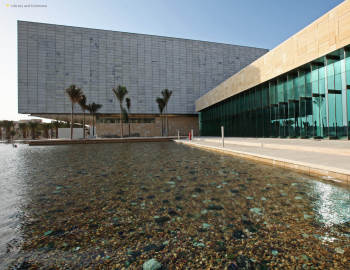
- KAUST, Thuwal, Kingdom of Saudi Arabia by HOK. KAUST's new campus is the Kingdom of Saudi Arabia's first LEED certified project and the world's largest LEED Platinum project.


Kroon Hall


- Kroon Hall by Hopkins Architects and Centerbrook Architects & Planners. Replacing a brownfield site, Kroon Hall was charged with being a net zero energy building. The project has a mix of active and passive design measures and visible, invisible and interactive building features.

- Manassas Park Elementary School + Pre-K by VMDO Architects. The school is conceived throughout as a teaching tool that shepherds children along a path of environmental stewardship. Interior extended learning spaces offer views of the neighboring mixed oak forest, while elementary classrooms face shady moss and fern-covered learning courtyards featuring 'fallen' trees.

- Manitoba Hydro Place by Kuwabara Payne McKenna Blumberg Architects and Smith Carter Architects and Engineers. The project was designed utilising a formal integrated design process to achieve goals of energy efficiency, healthy workplace environment, urban revitalisation, sustainability and architectural excellence. At 88 kwh per sqm annually, from a demand side, it is the most energy efficient large office tower in North America, with a 66 per cent improvement over the standard.


355 11th Street


- 355 11th Street by Aidlin Darling Design. The project is a LEED-NC Gold adaptive reuse of an historic (and previously derelict) turn-of the-century industrial building. The design team implemented a strategy of introducing subtle perforations into new zinc cladding to allow light and air into the occupied spaces.

- Michael J. Homer Science & Student Life Center by Leddy Maytum Stacy Architects. The design encourages scientific inquiry, linking the school’s science curriculum to building functions throughout the seasons – how it breathes, resists gravity, conserves precious resources and generates energy.

- Omega Center for Sustainable Living by BNIM Architects. The Center has been designed to clean water, return the clean water to the local systems and educate users about the process. Eco-Machine technologies were selected to clean the water, utilising natural systems including the earth, plants and sunlight. The entire building and water process utilise site harvested renewable energy achieving a net zero energy system.

- Special No. 9 House by KieranTimberlake. The project was designed to provide storm-resistant, affordable and ustainable housing options for the residents of New Orleans’ Lower Ninth Ward displaced by Hurricane Katrina. Key goals were to create safe, healthy and dignified housing to residents in a flood-prone area and to empower residents to return to improved living conditions that take advantage of New Orleans’ climate.

- Twelve|West by Zimmer Gunsul Frasca Architects LLP. Twelve|West was designed to achieve the highest levels of urban sustainability and is expected to earn a platinum rating under LEED NC overall and LEED CI for the office floors. An emphasis was put on selecting low-impact materials, including salvage, reclaimed and FSC-certified wood. Much of the concrete building structure is exposed on the interior minimising the use of finish material and providing ample thermal mass.

The Texas State Capitol Building


The Texas State Capitol is located in Austin, Texas. It is the fourth building in Austin to serve as the seat of Texas government. It houses the chambers of the Texas State Legislature and the office of the Governor of Texas. Originally designed by Elijah E. Myers, it was constructed from 1882–88 under the direction of civil engineer Lindsay Walker, and a $75 million underground extension was completed in 1993. The building was added to the National Register of Historic Places in 1970 and recognized as a National Historic Landmark in 1986. It is the largest state capitol building in the United States. Although popularly believed to be the tallest capitol building in the U.S., the Louisiana State Capitol building is taller by 142 feet (450 feet tall) and Texas' is 308 feet tall. It has less square footage than the National Capitol in Washington, D.C., but is 14 feet taller. It is, however, the largest state capital building in terms of total square footage.

History

Construction of the Italian Renaissance Revival capitol building was funded through an article in the state constitution, adopted February 15, 1876, which authorized the sale of public lands for the purpose. In one of the largest barter transactions in recorded history, the builders of the capitol were paid with over three million acres (12,000 km²) of public land in the Texas panhandle; this tract later became the largest cattle ranch in the world, the XIT Ranch. The value of the land, combined with out-of-pocket expenses, added to a total cost of $3.7 million for the original building. It was largely constructed by convicts or migrant workers, up to 1,000 at a time. The building has been renovated many times, with central air conditioning installed in 1955 and the most recent refurbishments completed in 1997.

The cornerstone for the building was laid on March 2, 1885, Texas Independence Day, and the completed building was opened to the public on April 21, 1888, San Jacinto Day. The building was originally planned to be constructed entirely of limestone from Oatmanville (present-day Oak Hill), about 10 miles to the southwest. However, the limestone was found to have a high iron content after it began to discolor. Hearing of the problem, the owners of Granite Mountain near Marble Falls offered to donate to the state free of charge the necessary amount of pink granite as an alternative. While the building is mostly built of the Oak Hill limestone, most of it is hidden behind the walls and on the foundations. Pink granite was subsequently used in many state government buildings in the Austin area.

The capitol rotunda features portraits of every person who has served as president of the Republic of Texas or governor of the state of Texas. The south foyer features sculptures of Sam Houston and Stephen F. Austin made by Elisabeth Ney. The rotunda also acts as a whispering gallery. The capitol has 360,000 square feet (33,000 square meters) of floor space, more than any other state capitol building, and sits on 2 1/4 acres (.9 hectares) of land. The building has nearly 400 rooms and over 900 windows.

The Texas State Capitol was ranked 92 in the "America's Favorite Architecture" poll commissioned by the American Institute of Architects, that ranked the top 150 favorite architectural projects in America as of 2007. In a 2008 poll by the AIA, it was also ranked the number one state capitol.

Flatiron Building, 23rd Street, New York.


The Flatiron Building, which when constructed was called the Fuller Building, was one of the tallest and oldest skyscrapers in New York City.


It was completed in 1902. The building, at 175 Fifth Avenue in the borough of Manhattan, sits on a triangular island block at 23rd Street, Fifth Avenue, and Broadway, anchoring the south (downtown) end of Madison Square, is 85 feet (87 meters) tall.


The neighborhood around the building is called the Flatiron District after its signature building.

Wooden Inspiration : Ocho House


For those wooden furnishings fans out there, I have something for you. The Ocho House in the Santa Lucia Mountains, California, doesn’t look like a lodge but thanks to its extremely cozy arrangements it does make you feel like living in one.


The interior seems large because of the large windows and the tall ceilings, but comfortable at the same time thanks to the materials and colors used : butter beige, white, natural wood, dark brown and black.


What I like most? The wooden staircases, the huge door and the living room view down the valley. You?


But more than the wooden inspiration this is a highly sustainable house that uses overhanging green walls and a smart solar roof. That’s the reason it got the green Energy and Sustainability Honor award from the American Institute of Architects.

THE STORY OF FALLINGWATER


Fallingwater is recognized as one of Wright's most acclaimed works, and in a 1991 poll of members of the American Institute of Architects, it was voted "the best all-time work of American architecture."
It is a supreme example of Frank Lloyd Wright's concept of organic architecture, which promotes harmony between man and nature through design so well integrated with its site that buildings, furnishings, and surroundings become part of a unified, interrelated composition.
Wright embraced modern technology to achieve this, designing spaces for living which expressed architecturally the expansive freedom of the American frontier.
For Fallingwater, designed in 1935 for the Edgar J. Kaufmann family of Pittsburgh, Wright responded to the family's love for a waterfall on Bear Run, a rushing mountain stream.
Mimicking a natural pattern established by its rock ledges, Wright placed the house over the falls in a series of cantilevered concrete "trays," anchored to masonry walls made of the same Pottsville sandstone as the rock ledges. Although the house rises over 30' above the falls, strong horizontal lines and low ceilings help maintain a sheltering effect.
Almost as much floor space is taken up by outdoor terraces as indoor rooms.Construction began in 1936, and ended with the completion of the guest house in 1939. The Kaufmann family used Fallingwater in all seasons as a weekend or vacation home until the 1950's, when their son inherited it.
Edgar Kaufmann, jr., by then a Curator at New York's Museum of Modern Art, continued to use Fallingwater until he entrusted it to the Western Pennsylvania Conservancy in 1963. His gift was lauded by the architectural community as a commendable act of preservation during a time in which many Wright-designed buildings were being demolished or in serious states of disrepair.
Fallingwater is the only great Wright house open to the public with its setting, original furnishings, and art work intact. Almost all of the original Wright-designed furnishings are still in place. Fine art, textiles, objets d'art, books, and furnishings collected by the Kaufmann family from the 1930's through the 1960's are on view, and represent the eclectic tastes of a sophisticated, world-traveled family. Included in the collections are works by Audubon, Tiffany, Diego Rivera, Picasso, Jacques Lipchitz, Richmond Barthe, and woodblock prints by Japanese artists Hiroshige and Hokusai - gifts from Frank Lloyd Wright to the Kaufmanns.